
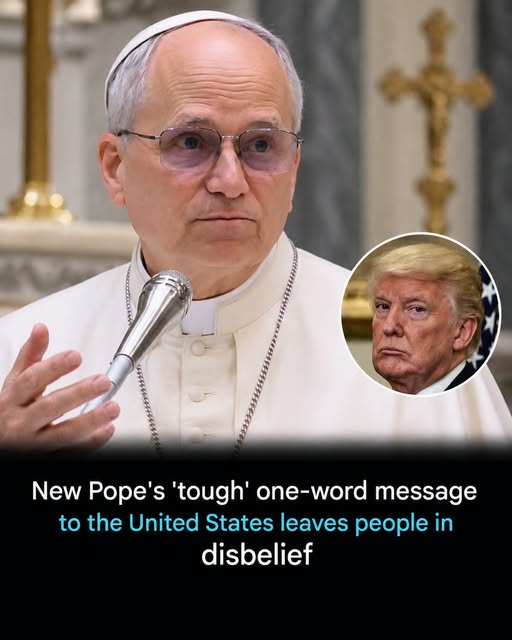
His answer was just one word.
But somehow, that one word landed harder than a thousand political speeches.
When Pope Leo XIV was asked a loaded question about America’s deepest problems, he simply answered: “Many.”
No speech. No partisan talking point. No carefully crafted soundbite.
Just one word.
And that was precisely what made it so powerful.
In a country where every public figure is expected to choose a side, name an enemy, and deliver a line designed for headlines, Leo XIV refused to play the game. He didn’t hand Washington a slogan that could be clipped, twisted, or weaponized. Instead, he left the question hanging in the air—forcing people to confront something far less comfortable:
America’s problems cannot be reduced to a single party, a single president, or a single issue.
“Many” carried the weight of an entire catalogue of wounds—poverty, racism, immigration, violence, inequality, political division, and a growing sense of spiritual exhaustion.
But he refused to rank those wounds for partisan applause.
That silence between the question and his answer may have said more than a lengthy political address ever could.
Because “Many” wasn’t necessarily an escape from the question.
It was a rejection of the question’s premise.
Leo XIV appeared unwilling to let either conservatives or progressives claim him as their political ally. His public record has included challenges to nationalist politics as well as criticisms of progressive blind spots on issues such as human life and labor. The message was clear: his role was not to become another player in America’s political battlefield.
It was to stand above it—and, when necessary, confront everyone on it.
That is what made the tiny answer feel so much bigger.
“Many.”
Four letters that refused to give America the comfort of a simple villain.
Four letters that turned the question back toward the country itself.
And perhaps that was the real message: sometimes the most uncomfortable truth is that there isn’t one problem to blame.
There are many.
And solving them begins with the courage to admit it.