
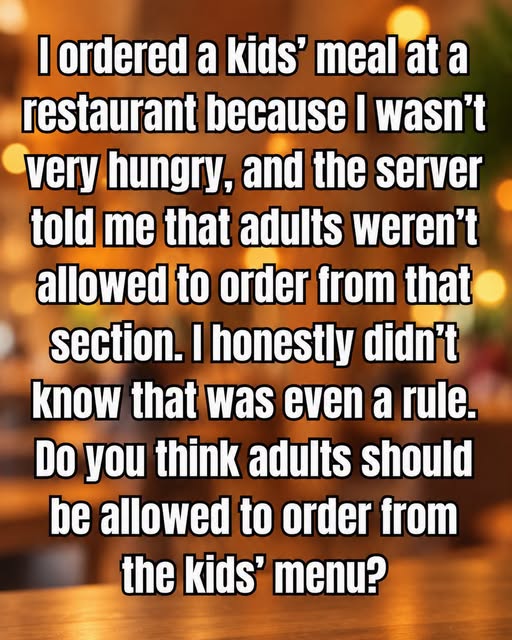
They’re adults. They’re paying customers. So why are some of them being embarrassed—or even refused service—when they ask for a kids’ meal?
It might sound like a small restaurant rule. A few chicken nuggets. A smaller burger. A cheaper plate. But behind that simple request is a surprisingly uncomfortable debate about money, dignity, appetite, and who gets to decide what an adult is “supposed” to eat.
For some people, ordering from the children’s menu isn’t about pretending to be a child. It’s about not wasting food. It’s about having a smaller appetite. It’s about stretching a budget when restaurant portions are far bigger than what they actually need.
And yet, the moment an adult says, “Can I order the kids’ meal?” the atmosphere can change.
A server may hesitate. A manager may step in. The answer might be a blunt, “Those are for children only.”
Technically, a restaurant can set its own menu policies. But emotionally, the experience can feel very different. What begins as a simple request can suddenly become a moment of embarrassment—as if choosing a smaller, cheaper meal somehow makes someone less deserving of being there.
And that’s where the real conversation begins.
Because this was never really about nuggets, fries, or a tiny cheeseburger.
It’s about the freedom to say, “That’s enough food for me.”
Restaurants have legitimate concerns, too. Pricing, portion costs, table service, and business margins all matter. If every customer could automatically choose the cheapest option, the economics of running a restaurant could become difficult.
But there’s a middle ground.
Instead of forcing the issue into a strict “kids only” versus “everyone can order it” battle, restaurants could offer smaller portions, half-sized entrées, affordable small plates, or adult mini-meals.
No judgment. No awkward confrontation. No making someone feel childish for knowing their own appetite.
And customers can meet restaurants halfway by understanding that businesses are allowed to set reasonable menu policies.
Maybe the answer isn’t about who is right.
Maybe it’s about creating a little more flexibility—and a lot more grace.
Because at the end of the day, a restaurant should be a place where people come to enjoy a meal, not defend their right to eat the amount of food they actually want.
Sometimes dignity looks surprisingly simple:
Let people order what fits their appetite, their budget, and their life—without making them feel ashamed for it.