
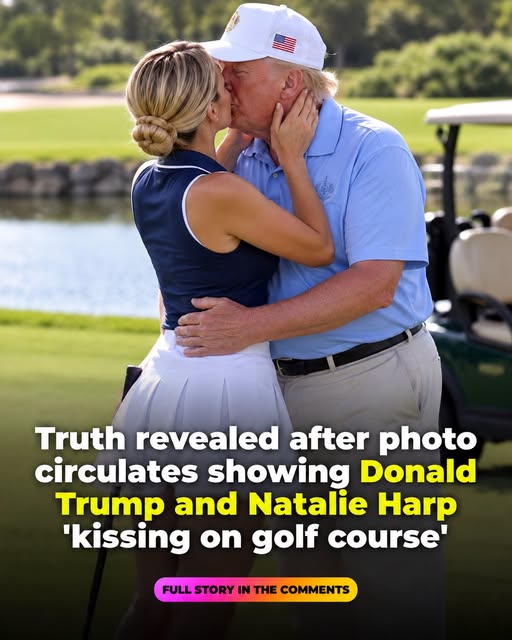
A single photograph was enough to ignite a political firestorm.
One viral image appeared to show President Donald Trump sharing an intimate kiss with his 35-year-old aide, Natalie Harp, at his Irish golf resort. Within hours, the internet erupted. Rumors of infidelity spread, questions about his marriage resurfaced, and allegations of betrayal collided with the machinery of political controversy.
But then, the image began to unravel.
As analysts examined the photograph more closely, strange distortions emerged—warped details, unnatural edges, and visual inconsistencies that raised serious questions about its authenticity. AI-detection tools also flagged characteristics commonly associated with manipulated or synthetic imagery.
What initially looked like explosive evidence began to look like something far more unsettling: a carefully constructed illusion.
The image may have gone viral as supposed proof of an affair, but it does not establish that an affair occurred. Instead, it highlights a growing threat in the age of generative AI: the ability to manufacture seemingly convincing “evidence” and unleash it into the public sphere before anyone has time to verify it.
Trump and Harp’s highly visible professional relationship made them especially vulnerable to speculation. Add political polarization, existing public controversies, and the speed of social media—and a fabricated image can quickly acquire the appearance of truth.
The deeper story is no longer simply about one photograph.
It is about what happens when seeing is no longer believing.
When an image can be manufactured in seconds, reputations can be damaged, relationships can be questioned, and political narratives can be reshaped—not because something actually happened, but because someone created something convincing enough to make millions believe that it did.