
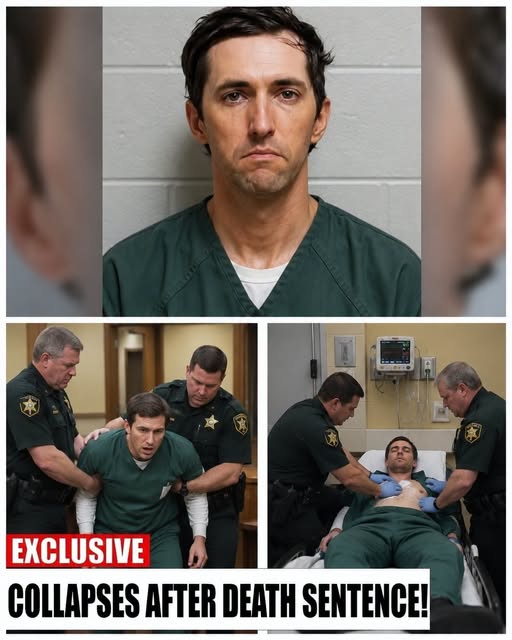
The verdict struck the room like a physical blow.
For one suspended heartbeat, no one seemed to remember how to breathe.
A man collapsed where he stood, and suddenly the law—so precise, so certain on paper—looked painfully, unbearably human.
Later, reporters would reduce the moment to a headline, a case number, a sentence handed down. But no article could capture the sound of that silence. They could not print the soft thud of a body giving way, the stunned expressions frozen across the courtroom, or the strange stillness that seemed to make even the judge appear smaller beneath the weight of what had just been spoken.
For those few seconds, before the machinery of justice began moving again, everyone in that room witnessed something raw. Something unfiltered. Something almost too painful to put into words.
They understood, perhaps for the first time, that accountability is never just a line in a legal document.
It has a face.
It has a family.
It has consequences that cannot be contained by a sentence or measured in years.
And it always comes with a human cost.
What remained with the people who witnessed the case was not the legal argument, the carefully prepared closing statements, or the technical language of the judgment. It was the moment time itself seemed to fracture when the sentence was delivered.
In an instant, one man’s future changed forever.
Yet the system surrounding him continued as if nothing extraordinary had happened.
They remembered the clerk staring silently at the floor. The juror nervously twisting a ring around a finger. The officer who, without a word, offered a quiet and almost reluctant kindness as he helped the fallen man back to his feet.
Those details never appeared in the transcript.
Years passed, and the case became something else entirely—a citation, a precedent, a reference point in arguments that followed. Its human reality slowly disappeared beneath layers of legal language and history.
But the people who had stood inside that courtroom carried something the official record could never fully preserve.
They carried the uneasy truth that justice, even when it does what the law requires, can still feel like something breaking.
Because a courtroom can hold two truths at once: righteousness and grief, accountability and compassion, consequence and loss.
And sometimes, the moments that remain with us longest are not the words spoken aloud.
They are the silences that follow them.