
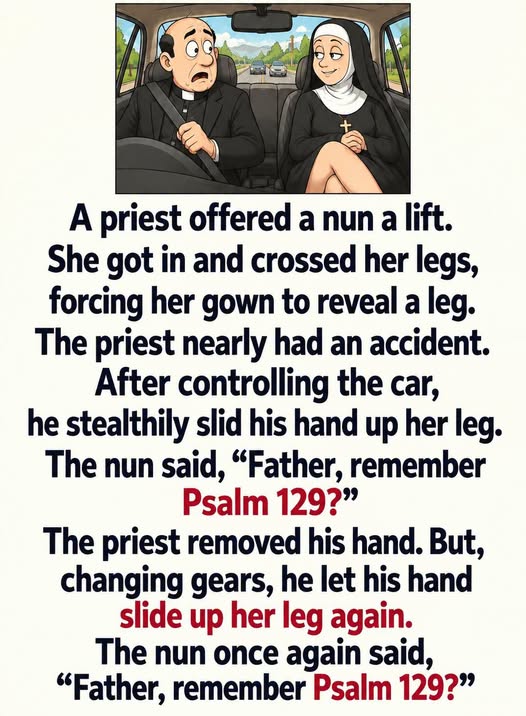
The first joke doesn’t merely flirt with scandal—it turns misunderstanding into the ultimate weapon. A priest, a nun, one suspiciously exposed leg, and a mysterious question: “Father, remember Psalm 129?” Every time his attention wanders, she repeats the same cryptic line. He has no idea what she means—until, much later, he finally reads the verse and realizes what he thinks she was really trying to tell him. By then, of course, it’s far too late. The ride is over, the opportunity is gone, and the joke has already landed.
All four jokes balance on the same razor-thin edge: two people hear the exact same words, but each is living in a completely different reality.
The priest thinks he’s being cautioned to keep his distance, only to discover that the message may have been a rather cheeky invitation—revealed only after the moment has passed. Little Johnny doesn’t have the patience to wait for wisdom; instead, he pulls God directly into the chaos with his little wagon, demanding practical help rather than a comforting answer. Then there’s Luigi, whose story initially sounds like a touching tale of decades-long romance and devotion—until one perfectly timed, deadpan sentence completely flips the meaning and makes you rethink their entire marriage.
Romi’s encounter with the “lift” sister takes the same idea to its most absurd extreme. The doctor speaks calmly and professionally, while Romi responds as though her strange interpretation of the situation is unquestionably real.
And that’s what ties all four jokes together. The punchline arrives the instant we realize we’ve been operating under the wrong assumptions. The words themselves haven’t changed—the meaning has.
That sudden shift is where the laughter lives: the moment an ordinary sentence cracks open an entirely different reality, and we realize we were standing on the wrong side of the joke all along.