
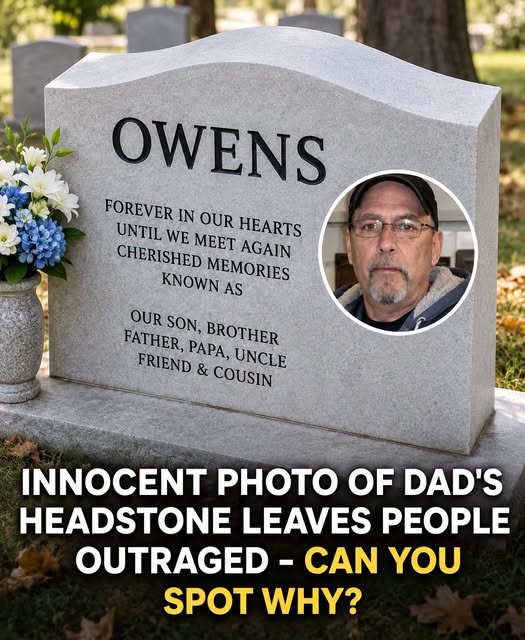
Grief erupted in a quiet cemetery—and no one saw it coming.
A single hidden word, carved into stone, has transformed a family’s private farewell into a bitter confrontation with a board of trustees. To the children, it was their father’s final joke: a mischievous signature from a man who never stopped being himself, even in death. To the cemetery, it represents something far more troubling—a crack in the standards meant to protect a place of mourning.
Behind the marble monuments and perfectly manicured grass, lawyers exchange careful whispers, trustees wrestle with uneasy policies, and one brutal question refuses to disappear:
Who gets the final say over a person’s last words?
At the heart of the dispute is a tiny acrostic carved into a headstone—a coded profanity that has exposed a much larger conflict between private memory and public space.
For the family, the message was never meant to offend strangers. It was an intimate final echo of the man they loved: irreverent, playful, unpredictable, and unwilling to treat death as an occasion for silence and solemnity. Being told to remove or soften that message feels, to them, like more than following a cemetery rule. It feels like erasing a piece of his personality—polishing away everything distinctive until only a sanitized version of him remains.
But the trustees see the stone from a different perspective.
They are not simply protecting one family’s memories. They are responsible for a landscape where hundreds, perhaps thousands, of people come to grieve. Their concern is that once one provocative message is permitted, the cemetery could gradually become a contest of personal taste rather than a shared place of peace and remembrance.
And that is what makes this conflict so difficult.
There is no simple answer to the question of who truly owns a legacy. Is it the family who carries a person’s memories? The individual who left those final instructions? Or the institution responsible for preserving a space where many people’s grief must coexist?
Perhaps the uncomfortable truth is that a legacy belongs, uneasily, to both.
It lives in the hearts of those who remember.
And it is permanently etched into the shared ground where those memories must exist beside everyone else’s.