
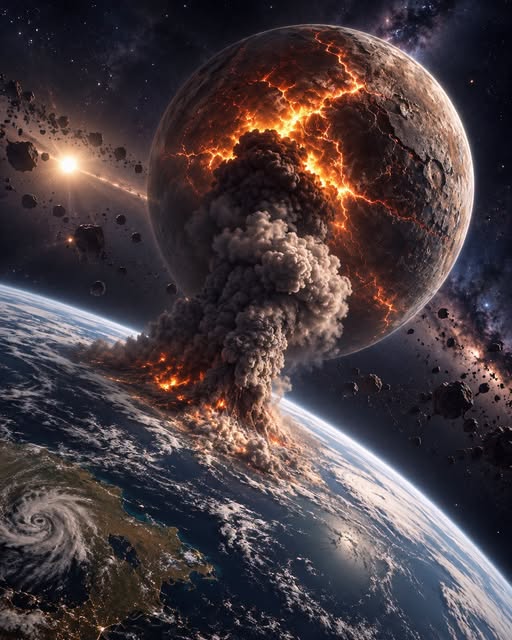
The warning arrived quietly—but the implications were anything but.
A mountain-sized asteroid is racing through the darkness of space. Officially, there is “no real danger.” Its trajectory is known, its distance is calculated, and this time, Earth is safe. Yet the object is enormous enough that, under different circumstances, an impact could devastate cities, reshape landscapes, and fill the atmosphere with dust capable of altering skies for years.
Scientists remain calm. Telescopes continue watching. Computers refine their calculations. The numbers offer reassurance.
But beneath that reassurance lies a far more unsettling question: How much of our safety depends on what we know—and how much depends on what we haven’t discovered yet?
An asteroid such as 52768 (1998 OR2) is more than a scientific object. It is a reminder of how fragile our place in the cosmos can be. On paper, it is simply mass, velocity, trajectory, and probability—a predictable traveler passing safely by our planet. But its journey also exposes an uncomfortable truth: Earth’s security is built not on guarantees, but on observation, preparation, and time.
Our planetary defense depends on telescopes detecting threats early enough. It depends on engineers developing solutions for problems that may never have been faced before. And it depends on governments being willing to act together before the clock runs out.
None of the vulnerabilities require a villain.
A delayed budget.
A missed observation.
A technical failure.
A disagreement that lasts just a little too long.
This asteroid will pass quietly into the darkness.
But somewhere beyond our sight, other objects are moving through the same darkness.
And one day, the question may not be “Are we safe?”
It may be:
“Did we see it coming soon enough?”