
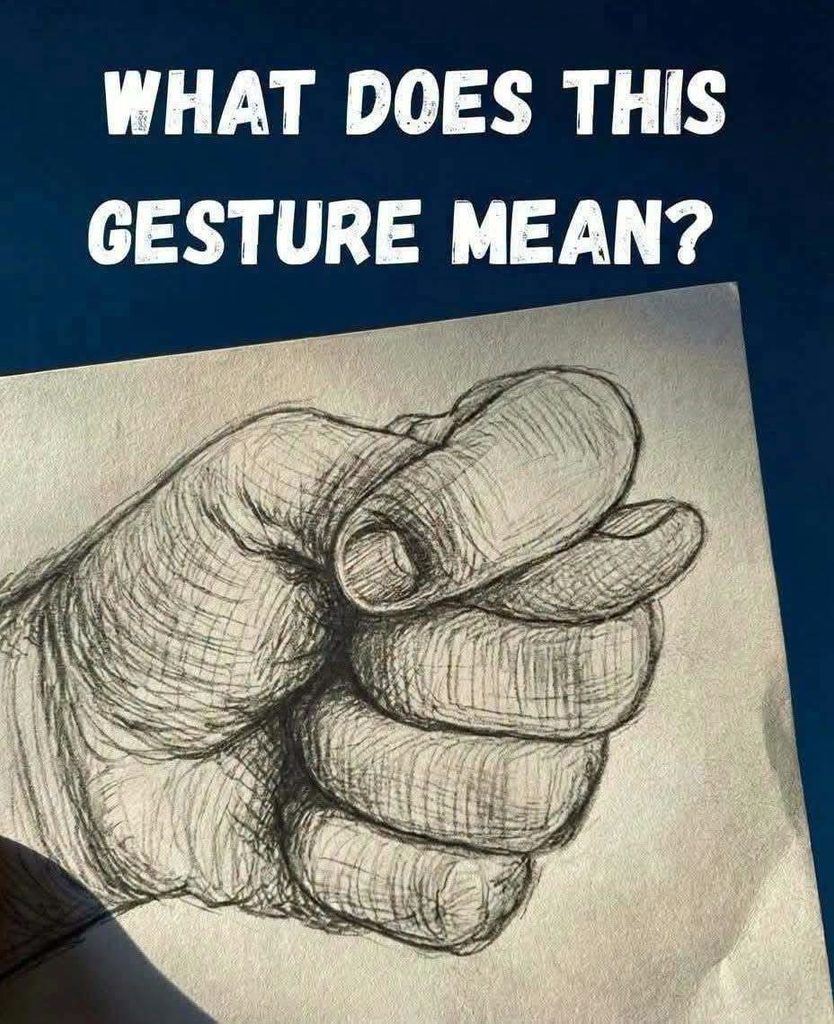
At first glance, it looks almost harmless: a closed fist, the thumb tucked quietly between the fingers—a gesture so small you could miss it in a crowded room.
Yet hidden inside that simple movement is a history far more powerful than it appears.
For centuries, the fig gesture has carried meanings of refusal, defiance, protection, and silent resistance. It could end an argument without a single word, signal a firm “no,” or serve as a private defense against forces people feared but could not see. Passed quietly through generations, it survived in family traditions, childhood games, and whispered lessons from grandparents to children.
In a world overwhelmed by notifications, messages, and endless noise, there is something strangely powerful about a gesture that needs no words at all.
The fig gesture was never merely a shape made by the hand. It was a subtle language—a way of navigating tension, power, fear, and emotion without openly confronting the person standing before you. With one small movement, someone could say, “No.” “Enough.” “I know what you’re doing.”
And perhaps that was its greatest power.
It occupied the delicate space between politeness and resistance. It allowed people to defend their dignity without turning disagreement into open conflict. Over time, its association with protection gave the gesture an even deeper meaning, transforming it from a simple sign of refusal into something resembling a tiny, invisible shield.
But cultures change, and meanings rarely remain frozen.
As generations passed, the seriousness of the gesture gradually softened. What once carried the weight of defiance and protection found new life in jokes, teasing, family rituals, and childhood play. Its transformation reflects something deeply human: the way cultures reshape old symbols, smoothing away their sharpest edges while quietly preserving their memory.
Today, many people may recognize the movement without knowing the story behind it.
And yet, the fig gesture remains—a small reminder that the human body has always been capable of speaking its own language.
Long before smartphones, notifications, emojis, and written messages, people communicated through movements, expressions, and signs. Sometimes, the most powerful message was the one never spoken.
All it took was a closed fist…
and a thumb hidden inside.