
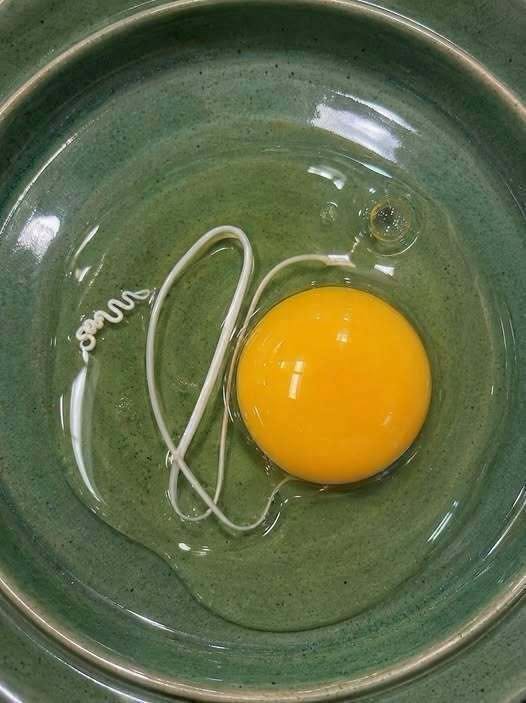
I was about to enjoy my breakfast when one strange detail made me stop cold. Floating inside the egg was a twisted white strand that looked so unusual, I immediately wondered whether something was wrong. Was it a parasite? Could the egg be contaminated? I checked the rest of the carton, hoping to find an explanation, but the more I looked, the more uneasy I became. Just as I was ready to throw everything away, I discovered a surprising truth that completely changed how I saw the strange object in my bowl…
It turns out that the mysterious white strand has a name: the chalaza. Far from being a dangerous intruder, it is a completely natural part of an egg. Made primarily of protein, these twisted, rope-like strands act like tiny anchors, helping keep the yolk positioned near the center of the egg. They are perfectly normal, safe to eat, and often more visible in fresh eggs. Their appearance can vary from one egg to another, which explains why you might notice a prominent white cord in one egg but barely see it in the next. What initially looked frightening was simply nature doing its job—not a worm, parasite, or sign of contamination.
The moment I learned the truth, my disgust turned into relief. But there is one important thing to remember: a normal-looking chalaza does not automatically mean an egg is safe to eat. Eggs should still be stored properly, handled carefully, and cooked thoroughly. If an egg has a cracked shell, an unusual appearance, or an unpleasant odor, it is best to discard it. Otherwise, there is usually no reason to remove the chalaza unless you are preparing a delicate dish that requires an especially smooth texture.
I had almost thrown away perfectly good breakfast because of something I didn’t understand. Now, the next time I crack open an egg and spot that strange white strand, I won’t panic. I’ll know that what once looked alarming is actually a fascinating little part of nature—and a reminder that sometimes, the things that frighten us most have the simplest explanations.