
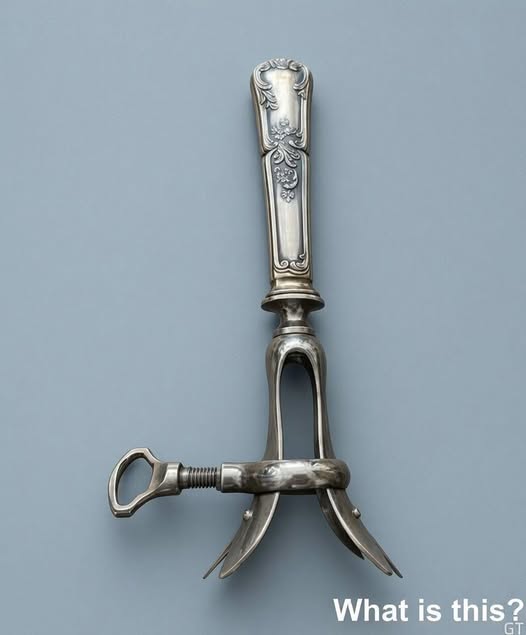
Those sharp prongs make this strange antique look almost sinister—but their real purpose was surprisingly refined.
At first glance, it could easily be mistaken for some bizarre instrument. Yet imagine it sitting on a beautifully set Victorian dining table, surrounded by silverware, crystal, candlelight, and formally dressed guests. In such a world, even carving the evening’s grand roast was expected to be done with grace and precision.
This curious object is a Victorian leg-of-lamb holder, also known as a manche à gigot—and it was designed to make carving a roast look effortless.
The pronged end gripped the joint firmly, while the tightening screw secured the meat in place. Its ornate handle gave the carver a steady, controlled grip, allowing portions to be served neatly without the roast slipping or shifting across the table.
And here’s where it gets fascinating: this was not merely a kitchen tool.
During the late 19th and early 20th centuries, formal dining was a carefully staged social performance. A host was expected to remain composed even while performing practical tasks in front of a room full of guests. Something as ordinary as carving a leg of lamb could become part of the evening’s ceremony.
That is why these holders were often made from silver or silver plate, decorated with elaborate floral motifs, scrollwork, and beautifully crafted handles. They were designed to complement fine tableware and were as much a display of craftsmanship as they were useful utensils.
Today, the manche à gigot is rarely seen in modern dining rooms. But surviving examples continue to fascinate antique collectors—not only because of their unusual appearance, but because they capture a vanished style of entertaining.
An age when dinner was more than a meal.
It was a performance.
And apparently, even holding the roast steady could be done with elegance, ceremony, and a little Victorian flair.