
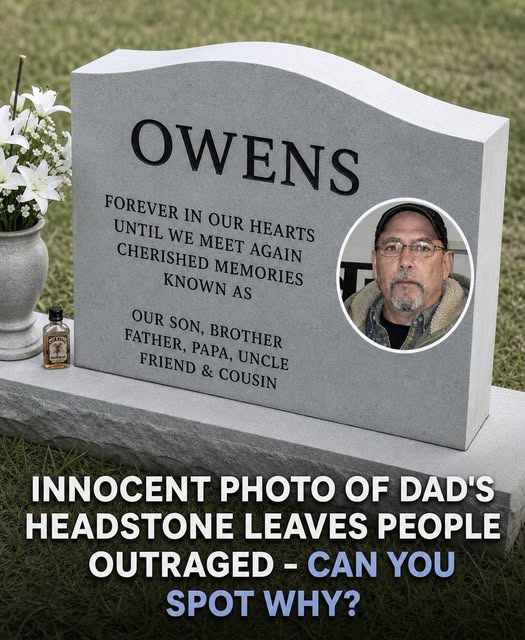
A gravestone was never meant to feel like a weapon. Yet this one does.
Hidden within a father’s final words is a single profanity—carefully concealed, quietly deliberate, and impossible to ignore once discovered. What should have been a peaceful corner of a cemetery has become the center of a fierce public battle. Families whisper. Cemetery trustees demand answers. Strangers online point fingers, mock the dead, and pass judgment. Love, grief, decency, ownership—every boundary has begun to blur.
What started as a private family joke is now permanently carved in stone, sitting at the heart of an argument far bigger than anyone expected.
To the children, the acrostic is more than a hidden vulgarity. It is a secret handshake with their father—a final shared joke with the man who taught them to laugh at life, to challenge convention, and never take the world too seriously. When they stand before his grave, they don’t see disrespect. They see warmth. They see memory. They see the mischievous father they knew—and a promise he made long ago that was finally kept.
But the cemetery trustees see something entirely different.
To them, the inscription represents a crack in the fragile order of sacred ground. If this profanity is allowed to remain, they fear the cemetery could slowly become a canvas for provocation, where personal expression begins to outweigh the dignity expected of the dead.
And somewhere between those two visions lies an uncomfortable truth:
A legacy is never completely private, and never completely public.
It belongs to the people who loved the person buried beneath the stone—but it is also exposed to the eyes of everyone who walks past it. The family sees a father. The trustees see a precedent. Strangers see a piece of stone and make their own judgment.
Perhaps that is the cruelest irony of all: the same words can mean love to those who remember the man and offense to those who never knew him.
And sometimes, no matter how carefully they are chosen, those two versions of a life simply cannot be carved into the same piece of stone.