
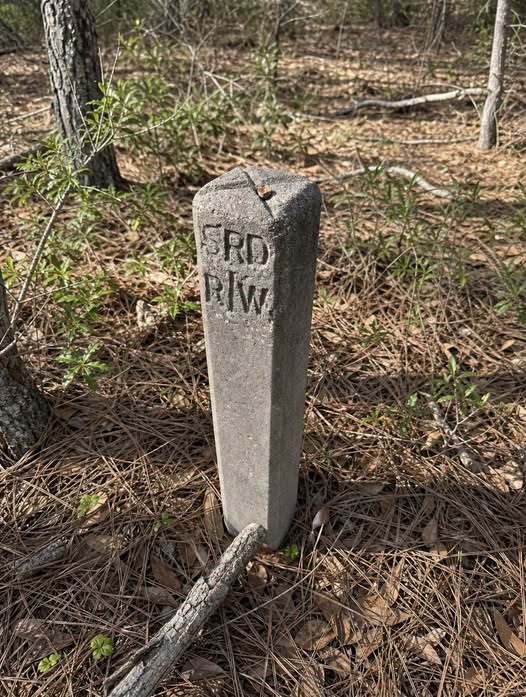
It was never designed to be beautiful.
Just a plain concrete post, standing knee-high among the weeds, weathered by decades of rain, frost, and time. And yet, it may be carrying a story far more important than its humble appearance suggests.
You might walk past it without a second thought.
Until you notice the letters stamped into the concrete: “R/W” or “SRD.”
Then you realize—you’re not looking at a random piece of old concrete.
You’re looking at a witness to a road that disappeared.
Long after the pavement crumbled, the signs rusted away, and the road itself vanished beneath trees and undergrowth, this small marker remained. Quietly marking the legal boundary of a right-of-way that once connected homes, farms, businesses, and communities.
And once you learn to recognize these forgotten markers, the landscape begins to tell a different story.
That shallow depression through the forest?
Maybe it was once a road.
That faint ridge beneath the grass?
Perhaps the remains of an old roadway.
Those scattered pieces of gravel hiding in the soil?
They may be the last traces of a route that people once traveled every single day.
Suddenly, what looked like an ordinary patch of woods becomes something else entirely—a map of a vanished world.
That’s what makes these little concrete posts so fascinating.
They remind us that history isn’t always found in grand courthouses, towering monuments, or massive iron bridges.
Sometimes, history is nothing more than a weathered piece of concrete standing alone in the weeds.
Silent.
Forgotten.
But still pointing to where the past once passed through.
Because ordinary places were once important to someone.
And sometimes, all that remains to prove it is one lonely marker refusing to disappear.