
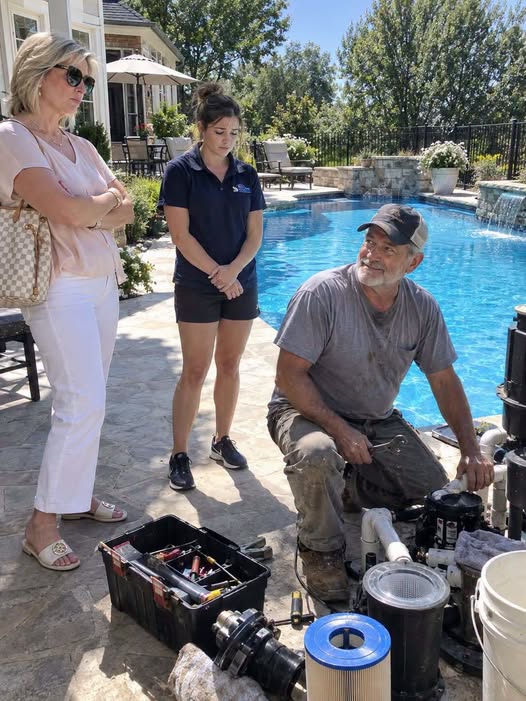
For twenty-nine years, my father had been fixing swimming pools.
At sixty-one, he could identify a dying pump just by listening to it. He understood water chemistry almost instinctively and noticed problems other technicians routinely overlooked. He wasn’t the kind of man who needed attention. He drove an aging Ford F-150, kept every tool exactly where it belonged, and recorded every job in the same battered spiral notebook he had carried for years.
Then one ordinary pool repair changed everything.
My boss, Richard Emory, hired my father to restore his neglected gunite pool. The job was extensive: a new pump, damaged pipes repaired, upgraded filtration, and days of careful work to bring the filthy water back to crystal clarity.
Nine days later, the pool looked brand new.
The bill came to $7,800.
Richard had signed the estimate and work authorization himself.
But when it was time to pay, his wife, Melissa, refused.
She offered my father just $3,000 and reminded him that her husband was my employer.
My father didn’t argue.
He simply looked at her and said, “I’ll handle it.”
Two days later, my phone rang.
“Come to Richard’s house,” my father said. “Right now.”
When I arrived, two police cars were parked outside.
My father was standing beside an elderly neighbor named Eleanor. Richard was arguing heatedly with the officers, his face red with frustration.
Then I learned what had happened.
While repairing the pool, my father had noticed something strange—a thick calcium deposit surrounding what appeared to be an old buried pipe.
Most technicians might have ignored it.
My father didn’t.
He carefully excavated the area.
And beneath the pool, he discovered a sealed metal box.
Inside were twelve antique watches and a small clock.
The collection had belonged to Tibor, a Hungarian watchmaker who had owned the property decades earlier.
And suddenly, Eleanor stepped forward with information that changed everything.
She had known Tibor.
For twenty-five years, she had kept his old records.
My father could have taken the watches and said nothing. Instead, he photographed everything, documented exactly where the box had been found, contacted Eleanor, and called the police.
He wanted the discovery handled properly.
Days later, Tibor’s seventy-three-year-old son, Martin, flew in from New Mexico.
The collection was worth nearly $90,000.
Thanks to my father’s careful documentation—and Eleanor’s records—Martin was able to establish his family’s ownership and the history of the collection.
Overwhelmed, Martin offered my father a $5,000 finder’s fee.
But that wasn’t the only surprise waiting for us.
Richard’s attorney had reviewed my father’s paperwork.
There was no loophole.
Both Richard and Melissa had signed the original work authorization.
That afternoon, Richard paid the full $7,800.
He even apologized to me for Melissa’s threat and made it clear that my job had nothing to do with my father’s invoice.
On the drive home, I finally asked the question I had been thinking about all day.
“Dad… did you ever think about keeping the watches?”
He was quiet for a moment.
Then he shook his head.
“They weren’t mine.”
He glanced through the windshield at the open road ahead.
“You don’t take what isn’t yours. You handle it correctly.”
Then he smiled.
“Sometimes, if you do the work right, everything else finds its way home.”
And somehow, after everything that had happened, those simple words felt worth far more than the $90,000 hidden beneath that swimming pool.