
A quiet winter forest can hide something far more unsettling than you expect—and it may reveal a disturbing truth about the way your mind sees the world.
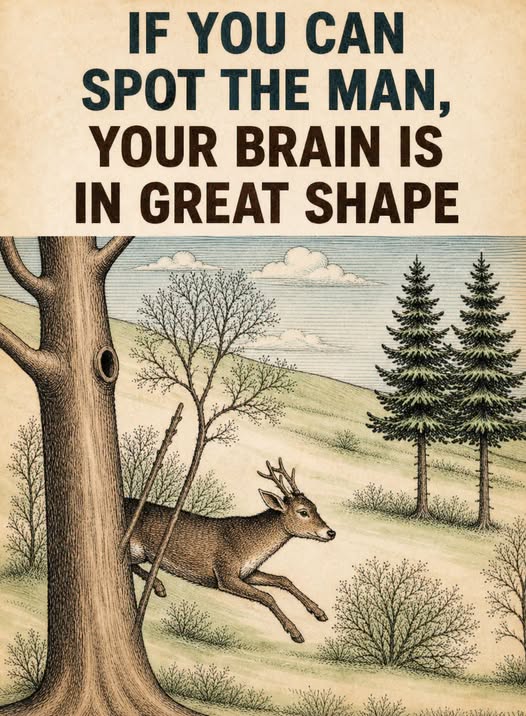
At first glance, the image seems almost effortless to understand. Snow blankets the ground. Tall trees disappear into the distance. And in the center, a proud deer stands perfectly still, demanding your attention. You think you’ve seen everything.
But you haven’t.
Your brain has already made a decision about what matters—and that decision is hiding something in plain sight.
Somewhere within the frozen forest, a human face is staring back at you, camouflaged among branches, shadows, and snow.
The deer is the trap.
Its sharp silhouette instantly becomes the focal point, allowing your brain to label the rest of the scene as nothing more than background. The trees become trees. The branches become branches. The patches of snow become meaningless shapes.
But try looking again.
Instead of focusing on the deer, follow the spaces between the trees. Let your eyes wander through the shadows. Slowly, the chaos begins to reorganize. Two dark patches become eyes. A branch forms the bridge of a nose. Shadows shape a cheek. And suddenly, a human face begins to emerge from the forest.
Once you see it, you may never be able to unsee it.
And that is what makes this illusion so fascinating.
Nothing in the image changes. No hidden object appears. No part of the picture moves. The only thing that changes is your perception.
What first appeared to be random trees and scattered shadows suddenly becomes a face that seems impossible to ignore.
The image is more than an optical illusion. It is a quiet reminder of how easily the human brain chooses the obvious answer—and stops searching.
So the real question isn’t just, “Can you see the face?”
It’s this:
What else in your life is sitting right in front of you, completely visible, yet hidden behind the first thing that captured your attention?