
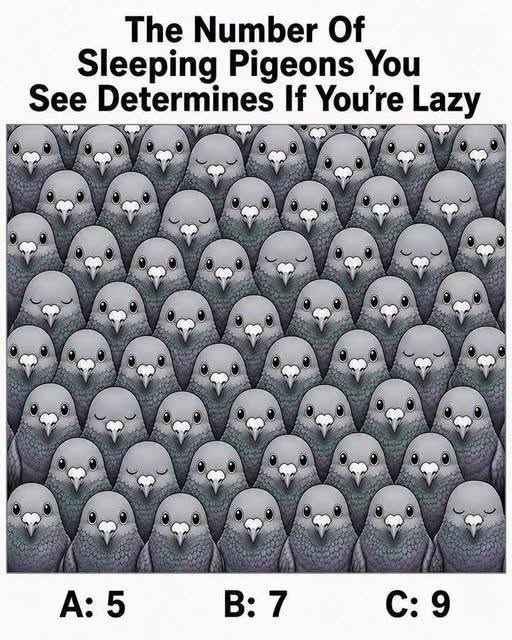
How Many Pigeons Did You See First? This Simple Puzzle Has People Comparing Answers
At first glance, it looks like an ordinary picture of pigeons.
But take a closer look.
How many did you notice first—5, 7, or 9?
That tiny detail is what makes this visual puzzle so interesting. Two people can stare at exactly the same image and come away with completely different answers. One person may immediately notice the larger shapes, while another starts picking out tiny details almost without thinking.
Before you decide what your answer “means,” though, there is one important thing to remember: this is not a scientific personality test, intelligence test, or psychological assessment. It is simply a fun visual exercise designed to make you think about how your eyes and attention move through a scene.
And sometimes, the way we look at a picture can be surprisingly revealing—not about who we are, but about what catches our attention first.
The Challenge Is Surprisingly Simple
Look at the image without overthinking it.
Then ask yourself:
How many pigeons did you notice first?
Did your eyes immediately settle on a few obvious birds? Or did you begin scanning the entire image, searching for every shape and detail you could find?
Your first answer can be influenced by completely ordinary things—image size, lighting, screen quality, viewing distance, your level of concentration, and even how quickly you made your decision.
So don’t treat the number as a diagnosis or a measurement of intelligence.
Instead, think of it as a quick observation game.
The fun begins when you compare your answer with someone else’s.
If You Saw 5 Pigeons First
If 5 pigeons immediately stood out to you, you may have been drawn toward the larger shapes and the overall structure of the image.
Rather than stopping to examine every tiny detail, your eyes may have taken in the scene as a whole first.
This kind of broad observation can be useful when you’re trying to understand the big picture—whether you’re planning something, considering possibilities, or trying to understand how different pieces fit together.
But there is a catch.
Sometimes the smallest details matter most. A second, slower look can reveal things your first glance completely missed.
If You Saw 7 Pigeons First
Did you count 7?
You may have naturally moved between the big picture and the smaller details.
Instead of focusing exclusively on one part of the image, you may have scanned enough of the scene to notice several different elements at once.
That kind of balanced observation can be helpful when comparing choices, gathering information, or looking at a situation from multiple angles.
But remember—this isn’t a label.
Seeing 7 pigeons doesn’t officially mean you have a particular personality type. It’s simply one possible way your attention interacted with this particular image.
If You Saw 9 Pigeons First
If your first answer was 9, you may have been paying closer attention to the smaller details hidden throughout the picture.
While someone else might stop after noticing the most obvious birds, your eyes may have continued searching, picking out shapes that weren’t immediately noticeable.
Detail-focused observation can be incredibly useful when accuracy matters—whether you’re checking information, solving a problem, finding mistakes, or trying to understand something complicated.
But even detail hunters can benefit from stepping back.
Sometimes, when you focus too closely on individual pieces, the overall picture becomes harder to see.
Here’s the Interesting Part
The most fascinating thing about this puzzle isn’t whether you saw 5, 7, or 9.
It’s that people can look at the exact same image and notice completely different things.
Our attention isn’t a perfect camera. We don’t process every part of a scene equally. We naturally notice some shapes, patterns, and objects before others.
And that’s why visual puzzles like this can be so entertaining.
One person might confidently say, “I saw 5 immediately.”
Another might look again and say, “How did you miss the others?”
Neither person is necessarily right or wrong in the way they observed the picture. They may simply have approached the image differently.
Don’t Take the Result Too Seriously
A visual puzzle cannot tell you whether you’re smarter, more successful, or more intelligent than someone else.
Your answer can change depending on the image quality, your attention level, screen size, lighting, viewing distance, and even whether you’re tired or distracted.
So the best way to approach this test is simple:
Have fun with it.
Show the image to a friend. Ask them how many pigeons they noticed first. Don’t tell them your answer until they’ve made their choice.
Then compare.
You might be surprised by how different your answers are.
And here’s the final challenge:
Look at the picture one more time.
Did you notice something you completely missed the first time?
Maybe the real puzzle isn’t how many pigeons you can count.
Maybe it’s how quickly your brain decides what deserves your attention.