
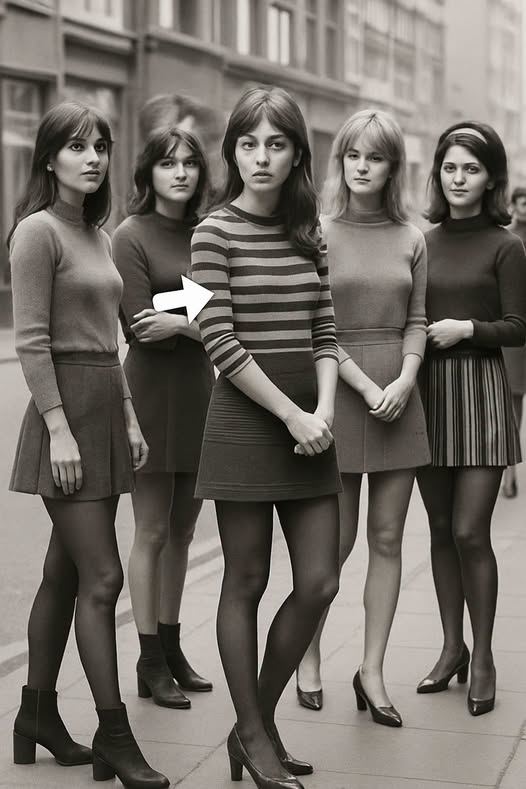
At first glance, you swear there’s nothing unusual about it.
Just an old, faded street photograph. A row of young women caught in a forgotten moment—skirts swaying, hair perfectly arranged, faces frozen in time. The kind of picture your eyes would normally skim past in a dusty attic box.
But then… something feels wrong.
You look again.
Your eyes drift downward, toward their legs. They’re strangely similar. Almost perfectly synchronized. Too identical to be coincidence. For a moment, you think you’ve cracked the mystery.
You haven’t.
Because the real shock is waiting much higher up.
And once you see it, you can’t unsee it.
What makes the photograph so unsettling isn’t some grotesque distortion or obvious visual trick. It’s something far more subtle: perfect sameness in a place where individuality should exist.
Look closely at their faces.
They aren’t merely similar.
They are the same.
Every woman is the same woman—repeated, repositioned, and transformed into an uncanny human pattern. What first appeared to be an ordinary snapshot suddenly becomes a visual puzzle.
The question is no longer, “Who are these women?”
It becomes:
“How was this photograph even possible?”
And that is where the story becomes even more fascinating.
This illusion was created long before Photoshop, digital editing, or computer-generated imagery. It required patience, precision, careful planning, and an almost obsessive attention to detail.
The photographer had to manipulate time itself—carefully reframing, re-exposing, and combining multiple images of the same subject until the final photograph appeared completely natural.
No obvious seams.
No dramatic clues.
Nothing screaming, “This is fake.”
And that ordinary appearance is what makes the illusion so brilliant.
The photograph quietly exposes one of the strangest weaknesses of human perception: we don’t always see what is actually there. We see what we expect to see.
Sometimes, all it takes to bend reality is a convincing surface—and someone willing to look closely enough to question it.