
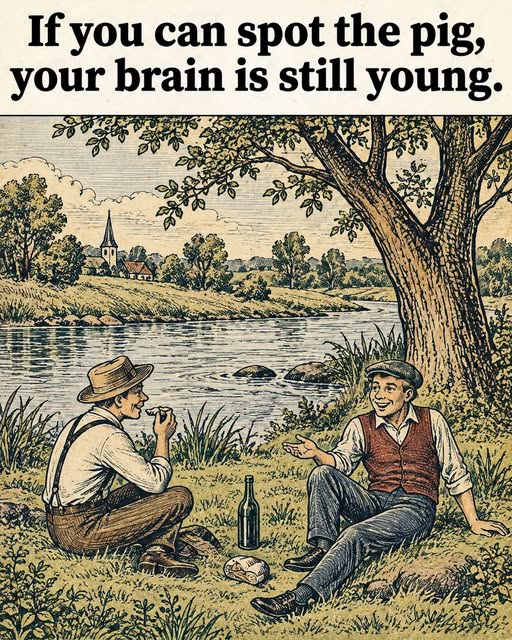
At first glance, the picture looks completely innocent. Two friends sitting peacefully at a quiet picnic, surrounded by bare trees and empty branches. Nothing unusual. Nothing suspicious.
But there’s a pig staring right at you.
You just can’t see it.
You look again. And again. Your eyes scan the branches, the people, the empty spaces—still nothing. It almost feels as if the picture is playing a trick on you. The more you search, the more strangely unsettling it becomes.
And that’s what makes this puzzle so fascinating.
The real trick isn’t the hidden pig. It’s your brain.
Without you realizing it, your mind immediately decides what deserves your attention. It identifies “people,” “trees,” “background,” and “empty space,” then filters out anything that doesn’t fit the story it has already created. The pig is right there, hidden within the image—but your brain has quietly decided that you don’t need to notice it.
Then, suddenly, you see it.
And everything changes.
The branches become an outline. Empty spaces transform into a snout. Random lines suddenly connect into the shape of a body. What seemed impossible to find a moment ago becomes so obvious that you wonder how you ever missed it.
Nothing in the picture changed.
Only the way you were looking at it changed.
That split-second of recognition is more than just a clever visual trick. It reveals something surprisingly powerful about how we see the world: our attention is selective, our assumptions shape what we notice, and certainty can disappear the moment we look at something from a different perspective.
Sometimes, the things we’re searching for aren’t hidden at all.
We simply haven’t learned how to see them yet.