
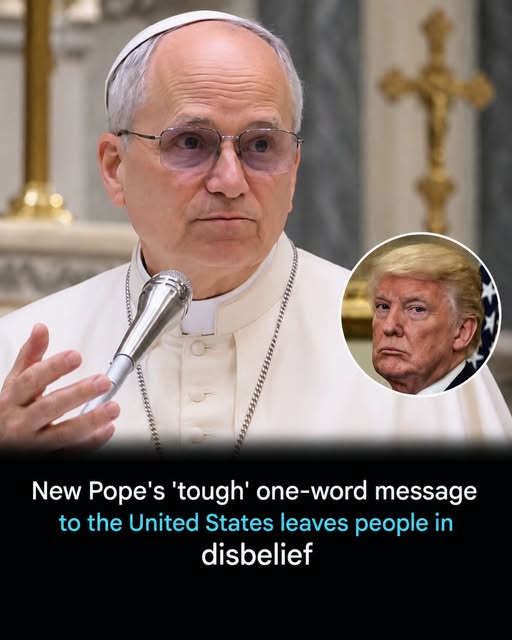
His answer was just one word.
Yet it rattled Washington more than a thousand speeches ever could.
When Pope Leo XIV was asked a loaded question about America’s problems, his response was strikingly simple: “Many.”
But there was nothing simple about what that word communicated.
He wasn’t dodging the question. He was refusing to be trapped by it.
In a single word, Leo XIV exposed the limitations of America’s partisan talking points—and signaled a papacy prepared to confront political power without becoming captive to it. He did not choose one crisis over another, one party over another, or one ideological camp over another. Instead, he pointed toward something far more uncomfortable: America’s problems are deeper, broader, and more interconnected than any political slogan can explain.
That is what made “Many” so powerful.
Its impact came not from its length, but from its refusal to follow the familiar rules of American politics. In a culture obsessed with instant opinions, viral soundbites, and tribal loyalty tests, Leo XIV declined to hand either side a convenient phrase to weaponize.
Instead, he offered something far more unsettling—a moment of moral reflection.
Behind that single word lies a catalogue of wounds: poverty, racism, migration, violence, inequality, political division, and a growing sense of spiritual exhaustion. Yet Leo refused to rank those wounds according to partisan convenience. He refused to tell Americans which problem mattered only because it benefited one political tribe.
“Many” forced the question back onto the country itself.
And that ambiguity should not be mistaken for weakness.
It can be understood as a deliberate strategy: to challenge both sides without becoming the champion of either. Leo XIV’s record of confronting nationalist politics while also questioning progressive blind spots on issues such as life, human dignity, and labor suggests a leader unwilling to simply echo whatever his audience wants to hear.
His one-word answer therefore carried a much larger message:
America cannot solve what it refuses to examine.
With “Many,” Leo XIV positioned his papacy not as another political voice competing for attention, but as a moral presence standing outside the usual partisan battlefield—pastoral when necessary, confrontational when required, and unwilling to let a divided nation hide behind easy answers.
Sometimes, the most powerful answer is not the one that tells people what they want to hear.
It is the one that makes them stop and think.