
Hope has returned to the Australian outback.
For years, the western quoll was little more than a whisper in the wild—a fading memory marked by scattered tracks in the red dust. Once widespread, this remarkable native predator had been pushed to the edge by habitat destruction, invasive predators, and a shrinking range.
Then, in a remote sanctuary, something extraordinary happened.
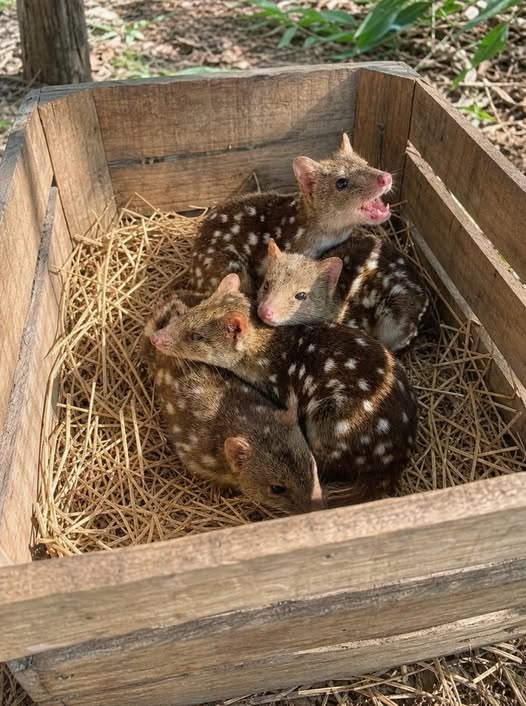
Researchers opened a mother’s pouch and discovered what conservationists had dared only to dream of: tiny, living western quolls.
A new generation.
A second chance.
At Mt Gibson Wildlife Sanctuary, these newborn quolls are far more than a conservation milestone. They are living proof that extinction is not always the end of the story. With determination, science, and years of careful work, a species can be given a pathway back.
But this miracle didn’t happen by accident.
Ecologists transformed the landscape—protecting den sites, restoring native vegetation, controlling invasive predators, and monitoring the animals around the clock with motion-activated cameras. In the darkness, those cameras captured something remarkable: quolls exploring, hunting, adapting, and reclaiming a place in the wild.
Among them was Aang, a quoll whose nighttime adventures became a symbol of what was possible.
Every grainy image was another sign of hope.
Every healthy mother was another victory.
And every tiny joey curled inside a pouch was a quiet revolution.
The western quoll is no longer just a memory in the red dust.
It is coming home.
And with every new generation, Australia’s lost hunters are getting another chance to roam, hunt, and shape their own wild country once again.