
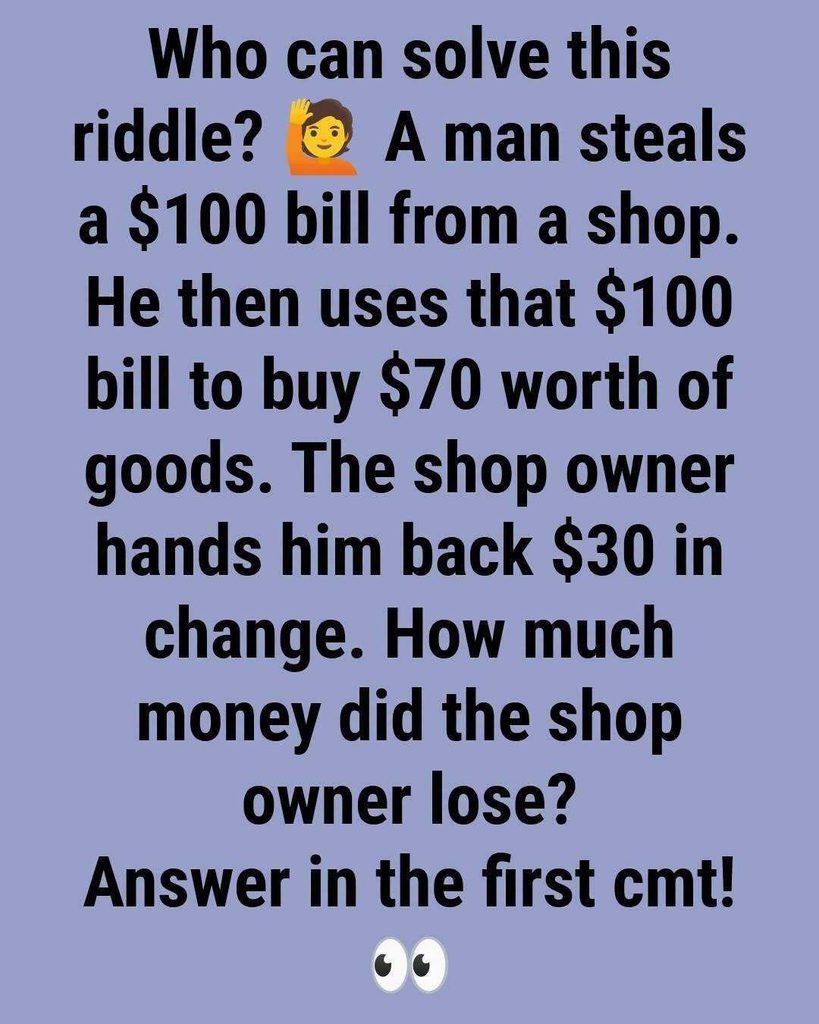
A thief walks into a shop and steals $100.
Then, in a bizarre twist, he uses that same $100 bill to buy $70 worth of goods.
The shop owner gives him $30 in change.
So here’s the question:
How much did the shop owner actually lose? 🤔
$100?
$170?
$200?
At first glance, the math seems confusing—but there’s a simple trick hiding in the transaction.
The key is this: the stolen $100 bill comes back to the shop.
Here’s what happens:
🔹 The thief initially steals $100 → the register is down $100.
🔹 He then spends that same $100 in the shop → the $100 returns to the register.
🔹 The owner gives him $30 in change → $30 leaves the register.
🔹 The thief also walks away with $70 worth of merchandise.
So what did the thief ultimately take?
$30 in cash + $70 in goods = $100.
That means the shop owner’s total loss is exactly $100—not $170, and not $200.
The original $100 bill cannot be counted again because it was returned during the purchase. Counting it twice is what creates the illusion.
The final answer: $100. 💵
Sometimes the hardest part of a puzzle isn’t the math—it’s knowing what not to count twice.