
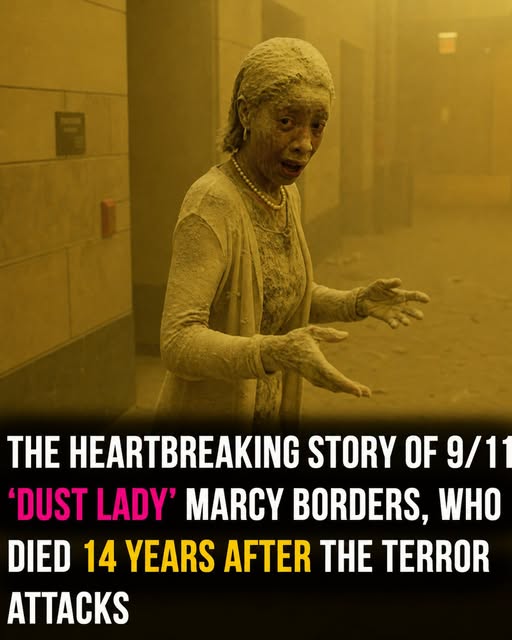
Marcy Borders thought she had survived the worst day of her life.
On September 11, 2001, she escaped the North Tower covered head to toe in ghostly gray dust. Her terrified face, frozen in a single haunting photograph, became one of the most unforgettable images of the tragedy.
But the world saw only the photograph.
It never saw what came afterward.
Marcy was just a young mother when she suddenly became a symbol of an entire nation’s trauma. While millions shared her image, she was fighting a private battle no camera could capture—nightmares, panic attacks, overwhelming fear of airplanes and skyscrapers, and a constant feeling that danger was still coming.
Her trauma eventually pulled her toward crack cocaine, isolation, and a devastating separation from her children. The woman recognized around the world felt almost completely invisible in her own suffering.
Then, slowly, she began fighting her way back.
Rehabilitation gave Marcy a second chance. Sobriety helped bring her children home, and for a brief time, she began to believe that surviving September 11 might finally lead to something beyond fear.
Then came another nightmare.
At only 42 years old, Marcy was diagnosed with stomach cancer.
She believed the toxic dust she had inhaled while escaping the tower had played a role in making her sick—a fear shared by many other survivors and first responders who later developed serious illnesses.
Marcy died in 2015.
Her story transformed that famous photograph forever. What once looked like a single frozen moment of survival became something far more heartbreaking: a reminder that for many September 11 survivors, the tragedy did not end when the towers fell.
For some, it followed them home.
And for Marcy Borders, the woman forever known as the “Dust Lady,” survival itself became a battle that lasted the rest of her life.