
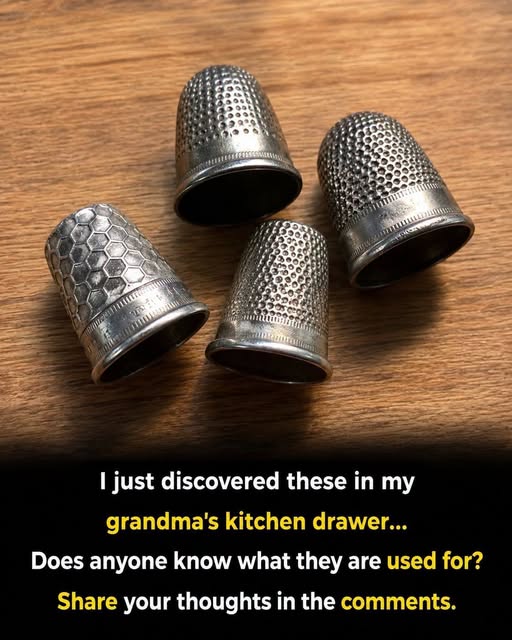
It may be one of the smallest tools ever invented, but the thimble has a history far bigger than its size.
For thousands of years, people have relied on simple forms of finger protection to push needles through tough materials such as leather, hide, and heavy fabric. Long before modern sewing tools existed, prehistoric craftsmen used pieces of bone, stone, and other hard materials to protect their fingers. These primitive inventions would eventually evolve into the familiar little cap we know today as the thimble.
By around 100 AD, the Romans were making thimbles from bronze, creating practical tools designed to protect the fingertip during hours of repetitive stitching. Similar examples have also been discovered in ancient China and other early civilizations, revealing that the need for safer, more efficient sewing was shared across cultures.
During the Middle Ages, thimbles became increasingly common throughout Europe. By the 14th century, tailors, embroiderers, and leather workers were regularly using small brass and bronze thimbles to shield their fingers from painful needlework. Most were simple and functional, either cast or hammered into shape by skilled craftsmen.
Then, during the 15th and 16th centuries, the thimble entered a new era.
The German city of Nuremberg became one of Europe’s leading centers of thimble production. Local craftsmen developed better brass alloys and more precise techniques, producing thimbles that were stronger, smoother, and more consistent. What had once been a handmade necessity was becoming a widely manufactured household tool.
By the 17th century, production had spread even farther, particularly throughout England and the Netherlands. Improved manufacturing methods allowed craftsmen to produce thimbles in greater numbers and with greater durability. But something else was changing too: the thimble was beginning to become beautiful.
Silver thimbles and other decorative versions started appearing, sometimes featuring intricate patterns and engraved designs. No longer simply something a worker needed, the thimble could also be something a person treasured.
By the 18th and 19th centuries, thimbles had taken on an entirely new meaning. Some were made from precious metals, engraved with names or messages, and given as gifts. Others became symbols of wealth, taste, and social status. Tiny as they were, these objects could carry enormous sentimental value—and many were carefully preserved as keepsakes.
The arrival of modern machinery eventually reduced the everyday need for thimbles. Sewing machines transformed the textile world, making large amounts of hand stitching unnecessary. Yet the thimble never disappeared.
Today, it remains a useful tool for quilters, seamstresses, embroiderers, and craftspeople. At the same time, antique and decorative thimbles have become sought-after collectibles, valued not only for their craftsmanship but also for the stories they carry.
From prehistoric pieces of bone to Roman bronze, medieval brass, elegant silver, and modern designs, the thimble has quietly followed humanity through thousands of years of craftsmanship.
It is small enough to fit on a fingertip—but behind that tiny piece of metal lies a remarkable story of invention, artistry, tradition, and human perseverance.
Sometimes, the smallest objects leave the biggest traces of history.