
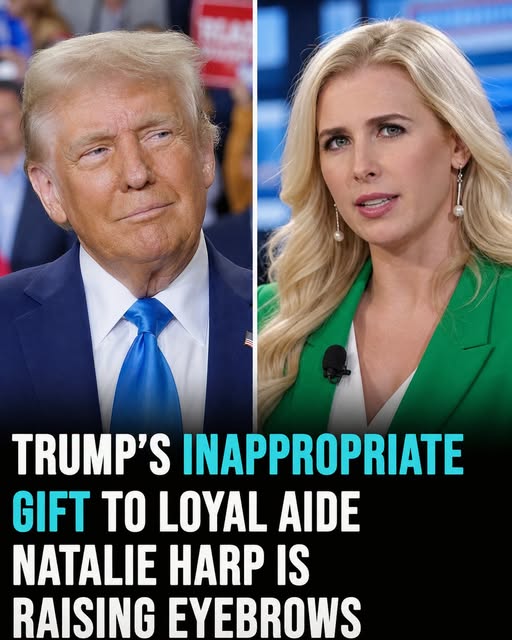
Natalie Harp may have believed she was simply proving her loyalty. Then came the envelope.
What was presented as a Christmas “gift” reportedly carried a staggering $45,000 in cash—an amount that immediately raised eyebrows among ethics experts and alarmed people close to Harp herself. What looked like a personal reward quickly became something far more troubling: a question about where devotion ends and public duty begins.
Harp’s relationship with Donald Trump has long appeared unusually intense. She has been portrayed as far more than an ordinary political aide—following him closely, helping shape the information he consumes, influencing his social-media messaging, and expressing an extraordinary level of personal devotion. In letters, she has reportedly written words suggesting that Trump occupies an overwhelming place in her life.
To supporters, that may look like unwavering loyalty. To critics, it raises a much darker question: has political service become personal allegiance?
The reported $45,000 Christmas payment only intensified those concerns. Ethics experts have questioned whether such a gift could conflict with federal rules designed to ensure that government employees remain loyal to the public interest—not financially or personally beholden to one powerful individual.
Even more striking, Harp’s own brother has reportedly described the relationship as “very unhealthy,” portraying it less like a conventional professional partnership and more like a personal devotion that has consumed her identity.
Whether the payment ultimately triggers legal consequences remains uncertain. But the controversy exposes a much larger issue—what happens when the boundaries between public service, personal loyalty, and private reward begin to disappear?
Because the real story may not be the $45,000 itself.
It may be what that money appears to represent: a political culture where loyalty can become currency, personal devotion can overshadow professional boundaries, and the safeguards designed to protect public institutions begin to look dangerously fragile.