
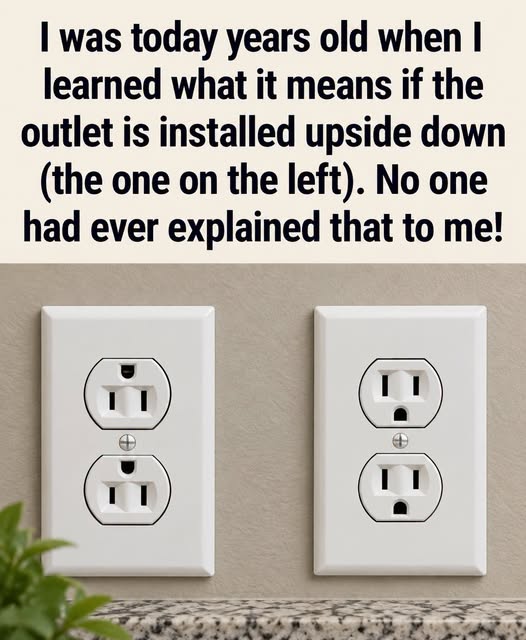
That “Upside-Down” Outlet on Your Wall Might Be Trying to Tell You Something
Have you ever noticed an electrical outlet that looks strangely upside down?
It might not be a mistake.
In some homes, that unusual orientation can be a subtle clue that the outlet is connected to a wall switch—especially in bedrooms and living rooms where there’s no original ceiling light.
Here’s how it works:
Before ceiling lights became standard in many homes, builders often used a switched wall outlet as the room’s primary light source. Plug a lamp into it, flip the wall switch, and suddenly the room lights up.
To make these outlets easier to identify, some electricians install the receptacle with the ground slot facing upward. It can serve as a visual signal: this outlet may be controlled by a switch.
And there’s another detail many people miss.
Sometimes, only one half of the receptacle is switch-controlled, while the other half remains powered all the time. That lets you turn a lamp on and off with the wall switch while still keeping a clock, charger, router, or other device powered.
But here’s the important part:
An upside-down outlet does NOT automatically mean it’s switched.
There is no national electrical code requiring switched receptacles to be installed upside down. The orientation could be a wiring convention, a safety preference, or simply the choice of whoever installed or replaced it.
So if you find one in your home, don’t assume—and definitely don’t assume it’s broken.
The easiest way to find out?
Plug in a lamp, then try the nearby wall switches. If the lamp turns on and off, you’ve just discovered a hidden piece of your home’s wiring history.
That “strange” outlet may not be strange at all.
It might have been giving you a clue the whole time.